

The Serbia national football team (Serbian Cyrillic: Фудбалска репрезентација Србије, romanized: Fudbalska reprezentacija Srbije) represents Serbia in men's international football competition. It is controlled by the Football Association of Serbia, the governing body for football in Serbia.
After the breakup of SFR Yugoslavia and its football team in 1992 Serbia was represented (alongside Montenegro) within the new FR Yugoslavia national football team. Despite qualifying for Euro 1992 the team was banned from participating in the tournament due to international sanctions, with the ruling also enforced for 1994 World Cup and Euro 1996 qualifiers. The national team played its first friendly in December 1994, and with the easing of sanctions the generation of the 1990s eventually participated at the 1998 World Cup, reaching the round of 16, and the quarter-finals at Euro 2000. The team played in the 2006, 2010, 2018 and 2022 FIFA World Cups, but failed to progress past the group stage on each occasion.
Between February 2003 and June 2006, Serbia participated as the Serbia and Montenegro national football team due to the countries' name change. Following a 2006 referendum Montenegro declared its independence, leading to separate football federations which resulted in the team's final renaming and establishment as the Serbia national football team. Serbia is considered by FIFA and UEFA to be the official successor team of FR Yugoslavia/Serbia and Montenegro national football teams, as well as the Kingdom of Yugoslavia/SFR Yugoslavia team.
Serbia within Yugoslavia (1920–1992)
The Football Federation of what was then the Kingdom of Serbs, Croats and Slovenes (later Yugoslavia) was founded in Zagreb in 1919 under the name Jugoslavenski nogometni savez (Yugoslavian Football Association). Jovan Ružić was the first Serb to represent the national team in its international debut match, a 7–0 drubbing by Czechoslovakia at the 1920 Olympic Games in Antwerp, Belgium.
In 1921, the Belgrade Football Subassociation organized a friendly match between the France national football team and a Belgrade XI, dubbed the "Serbian representatives". The team featured footballers from SK Jugoslavija and BSK, two of the Serbian clubs of the interwar period. The French delegation was on a four-game tour of Yugoslavia with the last exhibition game being played in Belgrade's SK Jugoslavija Stadium on 3 July. Prince Regent Aleksandar I and FIFA President Jules Rimet were in attendance as the visitors triumphed 3–0.
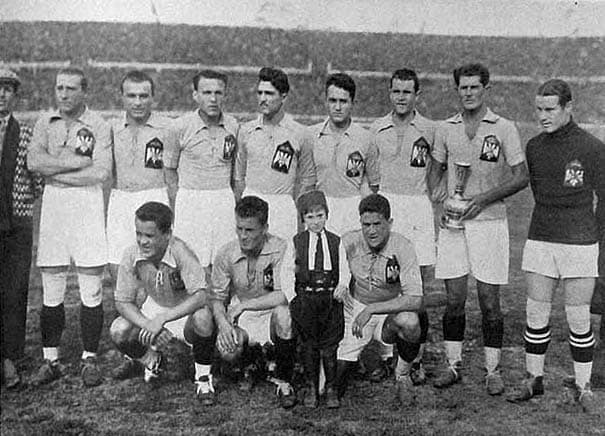
In the lead-up to the 1930 World Cup, a dispute regarding the relocation of the FAs headquarters from Zagreb to the capital Belgrade erupted, culminating in a boycott by the Zagreb Subassociation which disallowed its members to participate in the upcoming tournament. The de facto Serbian team led by coach Boško Simonović, composed largely of players from Belgrade's BSK, SK Jugoslavija and BASK, reached the semi-final, losing to hosts and eventual winners Uruguay 6–1. The royal interbellum era featured footballers such as Blagoje Marjanović, Aleksandar Tirnanić, Milorad Arsenijević, Đorđe Vujadinović, Branislav Sekulić and Milutin Ivković. Due to the dismemberment of Yugoslavia during World War II the football federation and national team ceased activities but reformed following the end of hostilities.
In 1945 Svetislav Glišović led the first unofficial national team representing the Federal State of Serbia in a tournament held to mark the end of World War II. The Serbian team encompassing the newly established Red Star squad won its first game by beating FS Montenegro 2–1, FS Croatia 3–1 in the semi-final, then proceeding to win the tournament against the Yugoslav People's Army team 1–0 in Belgrade.
The reconstituted Yugoslavia reached the UEFA European Championship finals in 1960 and 1968, and finished fourth place at the 1962 FIFA World Cup. During its existence Serbian footballers would continually play a major role in the Yugoslavia national team throughout the socialist era, with the likes of Rajko Mitić, Branko Stanković, Vladimir Beara, Vujadin Boškov, Todor Veselinović, Miloš Milutinović, Borivoje Kostić, Milan Galić, Vladimir Durković, Velibor Vasović, Dragan Džajić, Jovan Aćimović, Dušan Bajević, Vladimir Petrović and others until the states disintegrated in the 1990s. The national team of SFR Yugoslavia played its last game on 25 March 1992, losing 2–0 to the Netherlands.
Serbia on FootNews
All real-time news on the Serbia men's national football team (Serbia) from hundreds of sources: squad, call-ups, UEFA Nations League statistics, fixtures, market values and history.
 UEFA Nations League
 Vanja Milinković-Savić
 Filip Stanković
 Lazar Samardžić