

The Italy national football team (Italian: Nazionale di calcio dell'Italia) has represented Italy in men's international football since its first match in 1910. The team is controlled by the Italian Football Federation (FIGC), the governing body for football in Italy and a founding member of UEFA.
Italy plays its home matches at various stadiums across the country, while its training center and technical headquarters, the Centro Tecnico Federale di Coverciano, is located in Florence.
Italy is one of the most successful national teams in international football. It has won the FIFA World Cup four times (1934, 1938, 1982, and 2006), becoming the first team to successfully defend the title, and has also finished as runners-up in 1970 and 1994. Italy has won the UEFA European Championship twice (1968 and 2020), finishing as runner-ups in 2000 and 2012, and won the Olympic football tournament in 1936. Italy also finished third in the FIFA Confederations Cup (2013) and the UEFA Nations League (2021 and 2023).
The team is known as gli Azzurri (the Blues), after Savoy blue, the traditional colour of the House of Savoy. Italy has long-standing rivalries with Brazil, France, Germany, and to a lesser extent with Spain and England. The team has reached the top of the FIFA World Rankings in 1993 and 2007. Between 2018 and 2021, Italy set a record unbeaten run of 37 competitive men's international matches, which was surpassed by Spain in 2026. Italy has failed to qualify for the last three World Cups (2018, 2022 and 2026), marking its longest absence in the competition.
Origins and first two World Cup titles in 1934 and 1938
An early attempt to create an Italian national team occurred on 30 April 1899, when an Italian selection played a Swiss eleven, losing 0–2 in Turin. The team's first official match was held in Milan on 15 May 1910. Italy defeated France by a score of 6–2, with Italy's first goal scored by Pietro Lana. The Italian team played with a (2–3–5) system and consisted of De Simoni, Varisco, Calì, Trerè, Fossati, Capello, Debernardi, Rizzi, Cevenini I, Lana, Boiocchi, with Calì as the team's first captain.
The first success in an official tournament was the bronze medal at the 1928 Summer Olympics in Amsterdam. After losing the semi-final against Uruguay, an 11–3 victory against Egypt secured third place in the competition. In the 1927–30 and 1933–35 Central European International Cup, Italy achieved first place out of five Central European teams, topping the group with 11 points in both editions of the tournament. Italy would also later win the gold medal at the 1936 Summer Olympics with a 2–1 victory in extra time in the gold medal match over Austria on 15 August 1936.
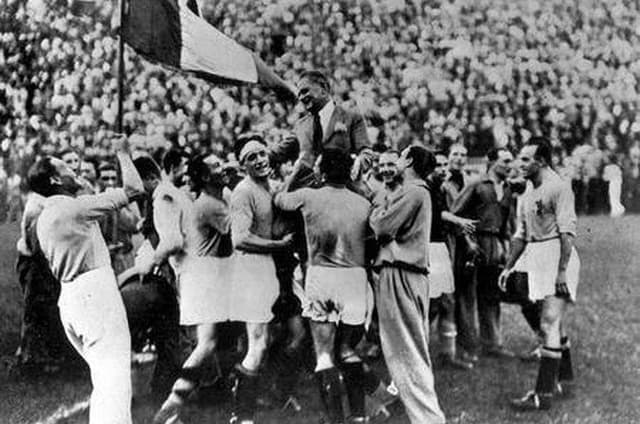
After declining to participate in the inaugural World Cup (1930, in Uruguay) the Italy national team won two consecutive editions of the tournament in 1934 and 1938, under the direction of coach Vittorio Pozzo and the performance of Giuseppe Meazza, who is considered one of the best Italian football players of all time by some. Italy hosted the 1934 World Cup, and played their first ever World Cup match in a 7–1 win over the United States in Rome. Italy defeated Czechoslovakia 2–1 in extra time in the final in Rome, with goals by Raimundo Orsi and Angelo Schiavio to achieve their first World Cup title. They achieved their second title in 1938 in a 4–2 defeat of Hungary, with two goals by Gino Colaussi and two goals by Silvio Piola in the World Cup that followed. It is rumored that before the 1938 finals fascist Italian Prime Minister Benito Mussolini sent a telegram to the team, saying "Vincere o morire!" (literally translated as "Win or die!"). However, no record remains of such a telegram, and World Cup player Pietro Rava said when interviewed: "No, no, no, that's not true. He sent a telegram wishing us well, but no never 'win or die'."
Italia on FootNews
All real-time news on the Italy men's national association football team (Italy) from hundreds of sources: squad, call-ups, UEFA Nations League statistics, fixtures, market values and history.
 UEFA Nations League
 Croazia
 Danimarca