

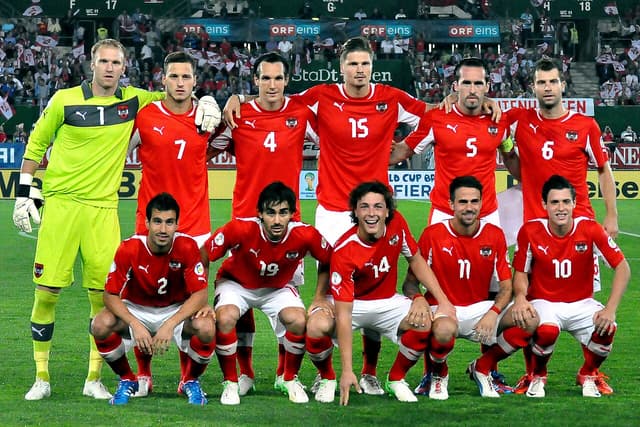
The Austria national football team (German: Österreichische Fußballnationalmannschaft) represents Austria in men's international football competitions, and is controlled by the Austrian Football Association.
The Austrian Football Association (ÖFB) was founded on 18 March 1904, in the Austro-Hungarian Empire. During the 1930s, under coach Hugo Meisl, Austria's national team, known as the "Wunderteam" (literally "Miracle Team"), became a dominant force in European football. Notable achievements included a fourth-place finish in the 1934 FIFA World Cup and silver medal at the 1936 Olympic Games. The Anschluss in 1938, which annexed Austria into Nazi Germany, led to the dissolution of the ÖFB and the obligatory integration of Austrian players into the German national team for the 1938 World Cup.
After World War II, Austria reestablished its national team and achieved significant success in the 1954 World Cup, finishing third. The team continued to be competitive throughout the 1950s and 1960s, including a notable victory over England at Wembley Stadium in 1965. However, the following decades saw fluctuating fortunes, with the team failing to qualify for FIFA World Cup in the 1960s and narrowly missing out on the 1974 World Cup in a playoff against Sweden. The 1970s and 1980s marked a revival, with Austria reaching the second round in the 1978 and 1982 World Cup, highlighted by a famous victory over West Germany in 1978.
The 1990s and 2000s brought challenges and disappointments, such as a defeat to the Faroe Islands in UEFA Euro 1992 qualifying, and a group-stage exit in the 1998 World Cup, their seventh and until then, last World Cup appearance. Austria automatically qualified for UEFA Euro 2008 as co-hosts with Switzerland, the first time they played in the UEFA European Championship, but was eliminated in the group stage. The country entered a resurgence in 2016, beginning with a successful qualification campaigns for the UEFA Euro 2016, Euro 2020, Euro 2024; and after 28 years of absence in the tournament, the 2026 FIFA World Cup, with current head coach Ralf Rangnick.
Pre-World War II
The Austrian Football Association (ÖFB) was founded on 18 March 1904 in the Austro-Hungarian Empire.
The team enjoyed success in the 1930s under coach Hugo Meisl, becoming a dominant side in Europe and earning the nickname "Wunderteam". The team's star was Matthias Sindelar. On 16 May 1931, they were the first continental European side to defeat Scotland.
In the 1934 FIFA World Cup, Austria finished fourth after losing 0–1 to Italy in the semi-finals and 2–3 to Germany in the third-place play-off.
There was controversy at the Peru v Austria match at the Football tournament of the 1936 Berlin Olympics. On 5 August, Austria beat Egypt 3–1 in their opening match. In the quarter-finals, Peru beat Austria 4–2 in extra-time. Peru had rallied from a two-goal deficit in the final 15 minutes of normal time. During extra-time, Peruvian fans allegedly ran onto the field and attacked an Austrian player. In the chaos, Peru scored twice and won, 4–2. Hitler called for a rematch, Austria protested and the International Olympic Committee ordered a replay without any spectators. The Peruvian national Olympic team refused to play the match again and withdrew from the games. The Peruvian government complained and their entire Olympic squad left in protest as did Colombia. Austria reached the final but were beaten 2–1 by Italy after extra time.
The team then qualified for the 1938 World Cup finals. Austria was annexed to Germany in the Anschluss on 12 March of that year. On 28 March, FIFA was notified that the ÖFB had been abolished, resulting in the nation's withdrawal from the World Cup. The Anschluss led to the integration of Austrian players into the German national team for the 1938 World Cup, although not including Austrian star player Matthias Sindelar, who refused to play for the unified team. Austria's place remained empty and Sweden, which would have been Austria's initial opponent, progressed directly to the second-round by default.
Austria on FootNews
All real-time news on the Austria men's national football team (Austria) from hundreds of sources: squad, call-ups, UEFA Nations League statistics, fixtures, market values and history.
 UEFA Nations League
 Belgio
 Croazia
 Danimarca