
Athletic Bilbao news from every source, in real time: today's stories, matches, table and fixtures, the club's official content and its history, from eight La Liga titles to twenty-four Copa del Rey trophies in the unique Basque tradition of San Mamés.
 La Liga
 Alavés
 Atlético Madrid
 Barcellona
Athletic Club (Basque: Athletic Kluba; Spanish: Athletic Club), commonly known as Athletic Bilbao (Spanish: Athletic de Bilbao), or simply Athletic, is a professional football club based in the city of Bilbao, Spain. They are known as Lehoiak (The Lions) because their stadium was built near a church called San Mamés, which was named after Saint Mammes, an early Christian thrown to the lions by the Romans.
The team plays its home matches at the San Mamés Stadium. Its home colours are red and white striped shirts with black shorts.
Athletic are the fourth most successful club in La Liga with eight titles to their name. In the table of Copa del Rey titles, Athletic is second only to Barcelona, having won it 24 times. It is also the most successful Basque football club in both league and cup titles won. The club also has one of the most successful women's teams in Spain, which has won five championships in the Primera División Femenina.
The club is one of three founding members of the Primera División that have never been relegated from the top division since its inception in 1929, the others being Real Madrid and Barcelona. These three clubs, along with Osasuna, are the only four professional clubs in Spain that are not sports corporations; this means that the club is owned by its members, who elect the president. The president cannot invest his own money. Athletic's main rivals are Real Sociedad, against whom it contests the Basque derby, and Real Madrid, due to sporting and political identity; a minor rivalry also exists with Barcelona due to historical significance. At various points in the club's history, further Basque league derbies have been contested against Alavés, Eibar and Osasuna.
The club is known for its cantera policy of bringing young Basque players through the ranks, as well as recruiting players from other Basque clubs. Athletic's official policy is to sign players native to or trained in football in the greater Basque Country, which includes Biscay, Gipuzkoa, Álava and Navarre (in Spain), as well as Labourd, Soule and Lower Navarre (in France). Since 1911, Athletic has played exclusively with players meeting its own criteria to be deemed Basque. The club has been praised for promoting home grown players and club loyalty. The rule does not apply to coaching staff, with several examples of non-Basques head coach both from Spain and abroad having coached the first team.
Despite the implications of the name 'Athletic Club' in English, and unlike some of the other major Spanish teams which have several departments, it is not a multi-sport club, participating only in football, although sections for cycling and other sports existed prior to the Spanish Civil War in the 1930s.
Bilbao FC, Athletic Club, and Club Bizcaya
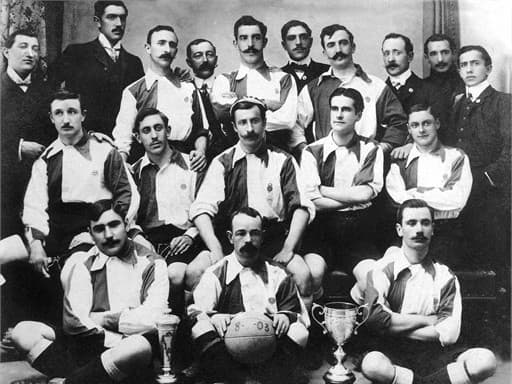
Football was introduced to Bilbao by two distinct groups with British connections: British workers and Basque students returning from schools in Britain. In the late 19th century, Bilbao was a leading industrial town, thus becoming the home to a large British colony, mainly made up of migrant workers, including shipyard workers and miners from various areas of England, such as Southampton, Portsmouth, and Sunderland. Along with coal, they brought with them (as in so many other parts of the world) the game of football. Meanwhile, sons of the Basque educated classes, such as Juan Astorquia, went to Britain to complete their studies, and while there they developed a deep interest in football. When they returned, they began to organize games with British workers at the Hippodrome of Lamiako, which at the time was the home of organized football in Biscay.
In 1898, Juan Astorquia and six other Basque students belonging to the Gymnasium Zamacois began to practice football in Lamiako. Three years later, in 1901, at a meeting held at the Café García, this group of football pioneers, now larger, began conversations to become a legalized official football club, which they called Athletic Club, using the English spelling. Luis Márquez became the club's first president, while Astorquia and Alfred Mills (the club's only foreign-born founder) were named the team's captain and vice-captain, but in 1902, Astorquia replaced Márquez as president, ruling from 1902 until 1903. Under his presidency, Athletic and their city rivals Bilbao Football Club reached an agreement to combine the best players of both sides to form a team known as Club Bizcaya, which was created to compete in the 1902 Copa de la Coronación (forerunner of the Copa del Rey which officially began a year later) held in Madrid; Bizcaya returned to Bilbao with the trophy after beating Joan Gamper's FC Barcelona 2–1 in the final. On 24 March 1903, Bilbao FC and its associates were officially and definitively absorbed by Athletic Club. The club itself declares 1898 as its foundation date.